TRAINING DAY
Marines practice combat tactics on South Padre Island beach
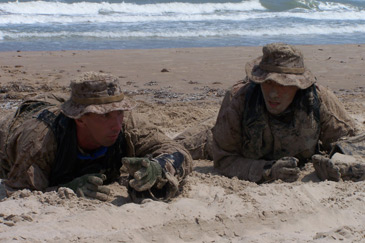 |
| Marines practice beach scouting exercises at Andie Bowie Park Wednesday. |
 |
 |
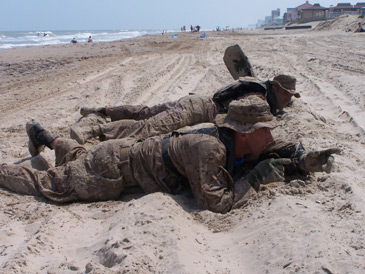 |
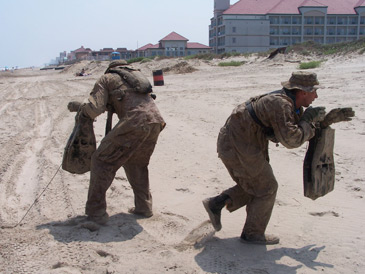
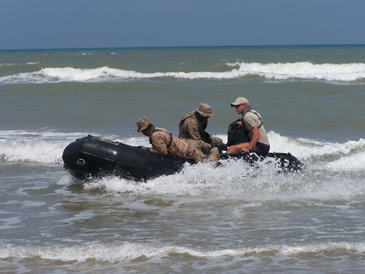
| (Daisy Martinez / Island Breeze) |
Marines from the 4th Recognizance Battalion from San Antonio underwent training on the beaches of South Padre Island this week.
Today will conclude the “amphibian” water-based training of 14 marines.
Staff Sgt. Ron Adkins said the Marine Corps as a whole fights from sea.
"Part of the job description for [Marines] is to scout and comb beaches ahead of landing before committing other assets to shore,” Adkins said.
The Marines, ranging from ages 19 to 27, learned how to swim ashore from 500 feet out, scout inland routes for defendable positions, check the soil and slope and identify offshore obstacles, Adkins said.
Raul Sanchez, hospital corpsman third-class, said the Marines in training were also learning water skills, such as dealing with zodiacs, how to maneuver small boats and teamwork.
This was the Marines’ second visit to the Island. The first training sessions were in December 2005.
Adkins said although the surf was “not so treacherous” at last winter, training on the Island was still fun.
Marines paired-up to practice the scouting exercise. In a real battle situation, the two marines would be responsible for determining whether an area is suitable for other troops and equipment to come ashore, Adkins said.
This technique can be used whether marines come ashore from a helicopter, boat or submarine.
In the past, the technique has proven worthy in battles in Korea and Somalia and will most likely be used by the Marines in Iraq, Adkins added.
Sgt. Chris Connelly has been with the San Antonio unit for five years. He said the toughest challenge of the training is having a strong “mental state.” But the training is also very physically demanding.
Connelly said the boats used for the training weigh approximately 400 pounds and that’s why teamwork is “vital.”
“I was once in their shoes,” Connelly said.
When things get tough and the trainees get discouraged, Connelly said, he tells them, “The only easy day is yesterday. You have to deal with the problems you have.”
Adkins said the Marines in training would not be tested but would be critiqued on techniques.
“It’s mainly for practice. We don’t get to train in water so often,” Adkins said. “They’re not superior swimmers yet.”
The majority of the Marines will transfer to stations in Southern California or the East Coast, and the experience gained on the Island will be valuable when they face colder waters, Adkins said.