Aug 1, 2006 - Floating Condos in Port Isabel
St.
Paul developer David Nelson is working on a
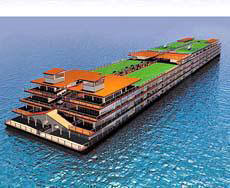
riverboat condominium project that would involve
a pair of 200-unit ships each consisting of four
barges going up four levels high. One of the
boats would spend summers in St. Paul and
winters in Port Isabel, Texas. The other
would cruise the nation's waterways year-round.
David Nelson impressed his biggest sceptics
after rescuing a sunken recreational boat from
the bottom of the St. Croix River. With equal
parts vision and elbow grease, he transformed
the 59-foot hull into a charming three-story
houseboat that he now moors at St. Paul’s
Harriet Island.
 While working on his house,
though, Nelson came up with a grander idea: Why
not build a larger vessel, like a floating
retirement community, that could treat its
residents to nautical adventures similar to his
own?
While working on his house,
though, Nelson came up with a grander idea: Why
not build a larger vessel, like a floating
retirement community, that could treat its
residents to nautical adventures similar to his
own?
More than a decade later,
the St. Paul native has finally translated that
dream into the most unusual condominium proposal
the city has ever seen. His River Cities concept
is a cross between a river barge and a
four-level, 200-unit cruise ship.
Condo buyers would tour
Nelson’s favorite haunts — from the sand bars of
Destin, Fla., to the riverfront parks in Memphis
— without ever leaving home.
One of his two planned
riverboats would spend the summer here and
migrate for the winter to Port Isabel on the
southernmost tip of Texas. The other would
cruise year-round on the nation’s waterways.
City planners and river
enthusiasts who have been meeting with Nelson
say they’re intrigued by his concept. But plenty
of attempts to revitalize St. Paul’s riverbanks,
including systems of sky gondolas and water
taxis, have come to naught.
His concept has also raised
questions about property taxes, docking rights
and the size and scale of each boat — Nelson
envisions them the length of five football
fields — making them the largest passenger
vessels on the Mississippi River.
“I talk to a lot of people,
and they say, ‘Wow, what a cool idea,’ ” said
Nelson, 53. “But whether it actually grabs
people enough that they’ll say, ‘Yeah, I want to
buy,’ that’s always the key.”
Obstacles loom
Nelson, a residential and
marine contractor, has yet to secure such
essentials as financing and a mooring site in
St. Paul. His top choice, a spot on Harriet
Island near the High Bridge, already has raised
the hackles of parks advocates who say that the
land should remain for public recreational uses.
The idea of a “floating
city” has blossomed throughout the country with
varying results. In March 2002, a Miami-based
ResidenSea launched its luxury residential ship,
The World. The company announced last week that
all of its 165 units — priced at $825,000 to
$6.3 million — recently sold out.
At least three other
companies targeting the seriously well-to-do
have lined up to capture the niche market, but
haven’t focused on the Mississippi River.
By contrast, Nelson’s
prices range from $275,000 to $474,000 for units
that go from 528 to 924 square feet. He said he
designed his model, comprising four adjoining
barges, to appeal to buyers who lack the means
to own a private yacht.
“I’ve got prices on this
thing where middle-class people can participate
in a millionaire’s dream,” he said.
But will it float?
Nelson has reacted to a
host of challenges while developing his plans
over the past two years. After conversations
with the U.S. Coast Guard, he and his architects
redesigned the ships with all-steel construction
and special attention to fire safety. Each boat,
powered by motors in back, would be designed to
split in half to pass through tight channels.
The Coast Guard appears to
have no laws that would prohibit this kind of
boat from traveling the inland and intra-coastal
waterways, said Lt. Cmdr. Patrick Clark, chief
of the prevention department for the Sector
Upper Mississippi River in St. Louis. Technical
experts would review Nelson’s application in
light of strict standards for passenger vessels,
Clark said.
But it hasn’t stopped Clark
from scratching his head.
“I’ve been in the marine
safety field for 14 years, and I’ve never
encountered a vessel like this,” Clark said.
“It’s basically a floating homeowners’
association. The concept he has — each person
has their own galley and can do their own
cooking — it’s not something we normally see.”
Nelson’s plan could make
waves with city parks officials. His preferred
docking site near the High Bridge would give
residents the option of parking their cars on
shore during the summer. The St. Paul Yacht Club
allows its members to store their boats there in
winter, and the city occasionally uses the space
for overflow parking and equipment storage for
festivals.
But Harriet Island isn’t
intended to serve residents of a private
residential development, said Bob Bierscheid,
director of the city’s parks and recreation
department.
“Frankly, it’s so huge, it
would block that section of the river,” said
parks advocate Peggy Lynch, a member of a
citizens committee proposing stricter rules for
the Mississippi River.
Unlike with controversial
riverfront proposals such as the Bridges of St.
Paul, Nelson is not asking for city subsidy. As
riverboat residents, however, Nelson’s condo
buyers would not pay property taxes — an
arrangement that raises questions about how St.
Paul would provide city services, said Cecile
Bedor, director of planning and economic
development.
“Our initial observation is
it’s interesting and intriguing,” Bedor said.
“I’m not sure that having a large barge of
housing on the river necessarily promotes
further development of the riverfront, but it
may.”
‘I’m selling a lifestyle’
Perhaps the biggest
challenge will come from the market itself.
Nelson is readying to launch his idea at a time
when gas prices have skyrocketed and condo sales
have sagged. He estimates it would take at least
$80 million to build each boat over roughly 2½
years.
Given the novelty of his
dreams, Nelson has struggled to find financing
for construction and individual mortgages.
Residents would share annual maintenance and
cruising costs, ranging from $8,200 to $21,700
per unit.
Nelson says he’s selling
greying boomers a lifestyle of ever-changing
scenery without the hassles of boat maintenance.
Whirlpools and putting greens can entertain them
on board. At each port, residents would explore
downtowns and beaches as well as take advantage
of rental cars arranged by the crew.
“What’s unique about this
is that these people will have a sense of
ownership of the entire Mississippi River that
few other people would,” said Patrick Seeb, head
of the St. Paul Riverfront Corp.
“These projects are never
easy,” he said, referring to ambitious
riverfront proposals that include the Bridges,
which Seeb has criticized. “You have to hand it
to people for being creative and trying to find
ideas unique in the marketplace. … I know some
day there will be a water taxi in St. Paul.”
Nelson admits he’s never
faced such a test, even when at age 30 he put
together a small Lake Elmo subdivision. His
biggest marine contracting job was a
head-turning, $1 million remodel of a
Victorian-style paddlewheeler into a posh living
space.
“I
really am just a small guy that’s trying to do a
really big thing,” he said. “I want to let
people know that if they’re as excited about
this project as I am, then join me. I will give
them one of the neatest lifestyles as any
retired person in this country, but I do need
their support.”